If you think TikTok’s For You Page (FYP) is random, you’re leaving real growth on the table. The FYP is powered by one of the most sophisticated recommendation systems in social media, and every like, skip, and rewatch feeds it data. Once you understand how this system actually works, you can stop guessing and start making content decisions that drive measurable results. This article breaks down the algorithm’s core mechanics, the ranking signals that matter most, and the practical strategies you can use to get your content in front of more of the right people.
Table of Contents
- Understanding the TikTok For You Page algorithm
- Key signals TikTok uses to rank your content
- Personalization, prediction, and how the ‘feedback loop’ controls reach
- Practical strategies to boost your TikTok content’s performance
- Why most creators misunderstand TikTok’s For You Page—and what actually works
- Take your TikTok growth to the next level
- Frequently asked questions
Key Takeaways
| Point | Details |
|---|---|
| Algorithm isn’t random | The For You Page uses machine learning to rank videos by individual user behavior. |
| Early retention is key | Videos that quickly engage and retain viewers are most likely to reach wide audiences. |
| Negative signals hurt reach | Skip rates and ‘Not Interested’ clicks reduce your content’s visibility. |
| Personalization is ongoing | Every user interaction updates the prediction score and affects future recommendation patterns. |
| Improve with analytics | Leveraging TikTok’s analytics and making iterative content changes drives better results. |
Understanding the TikTok For You Page algorithm
Now that you know the For You Page isn’t purely random, let’s see what’s actually happening behind the scenes.
TikTok’s FYP is powered by a machine learning recommendation system. It doesn’t just show popular videos to everyone. Instead, it calculates a personalized prediction score for each video and each user, then serves the highest-scoring content to that specific person. This is why two people on TikTok can have completely different feeds even if they follow the same accounts.
According to TikTok’s own documentation, the For You feed uses engagement signals to estimate a prediction score, and high-scoring videos are the ones that get recommended. The system is constantly learning. Every time you watch a video to the end, skip it in two seconds, or leave a comment, you’re feeding the algorithm new data that refines what it shows you next.
The machine learning model at the core of TikTok’s system ranks videos by predicted retention and time spent watching. This means the algorithm isn’t just counting likes. It’s predicting whether a specific user will actually watch your video and engage with it meaningfully.

Here’s a simplified breakdown of how the prediction score works:
| Signal type | Examples | Impact on score |
|---|---|---|
| Positive engagement | Likes, comments, shares, rewatches | Increases score |
| Completion signals | Watch time, finish rate | Strong positive impact |
| Negative engagement | Skips, “Not Interested” taps | Decreases score |
| Content context | Hashtags, sounds, captions | Helps targeting |
| Account context | Region, language, device | Refines delivery |
Key behaviors the algorithm monitors include:
- Video completion rate: Did viewers watch the whole thing?
- Rewatches: Did anyone loop the video?
- Shares: Did viewers send it to others?
- Comments: Did the content spark a reaction?
- Profile visits: Did the video make someone want to know more about you?
“TikTok’s recommendation system uses engagement signals to estimate a prediction score; high-scoring videos are recommended to users on their For You feed.” — TikTok Transparency Center
The model refines itself with every interaction. This is what makes TikTok’s algorithm so powerful and why understanding it gives you a genuine competitive edge as a marketer or creator.
Key signals TikTok uses to rank your content
Understanding the algorithm’s backbone is crucial. Now, let’s map out exactly which signals influence your content’s rank, and how you can target them.
TikTok evaluates your content across three major signal categories: interaction signals, content signals, and account signals. Knowing which category each factor falls into helps you prioritize your optimization efforts.
As TikTok confirms, signals considered include engagement behaviors and video, device, and account context such as region, sounds, and hashtags. No single signal controls everything. The system weighs them together.
Interaction signals are the most direct feedback the algorithm receives. These include:
- Views and watch time: How long did people actually watch?
- Completion rate: What percentage of viewers finished the video?
- Likes: A basic positive signal, but not the most powerful one.
- Comments: Comments signal strong engagement and keep viewers on the video longer.
- Shares: One of the strongest signals because it means someone valued the content enough to send it elsewhere.
- Profile visits: Indicates the video made someone curious about you as a creator.
- Skips and drop-off points: Where exactly do people leave? This tells TikTok which parts of your content fail to hold attention.
Content signals help TikTok understand what your video is about and who might want to see it:
- Hashtags you include
- Sounds and music you use (especially trending audio)
- Video length and format
- Captions and on-screen text
- Time and day of posting
- Geographic region
Account signals provide context about your history on the platform:
- Your prior engagement rates
- The types of content your audience has previously responded to
- Device type and operating system
Negative signals deserve special attention. Most creators focus only on getting likes and views, but skips, “Not Interested” taps, and rapid drop-offs actively reduce your content’s recommendation score. A video with 10,000 views but a 20% completion rate will often underperform a video with 2,000 views and an 85% completion rate.
Boosting your TikTok likes and gaining TikTok followers both contribute to stronger interaction signals, which directly support your content’s ranking potential.
Comparison: high-performing vs. low-performing content signals
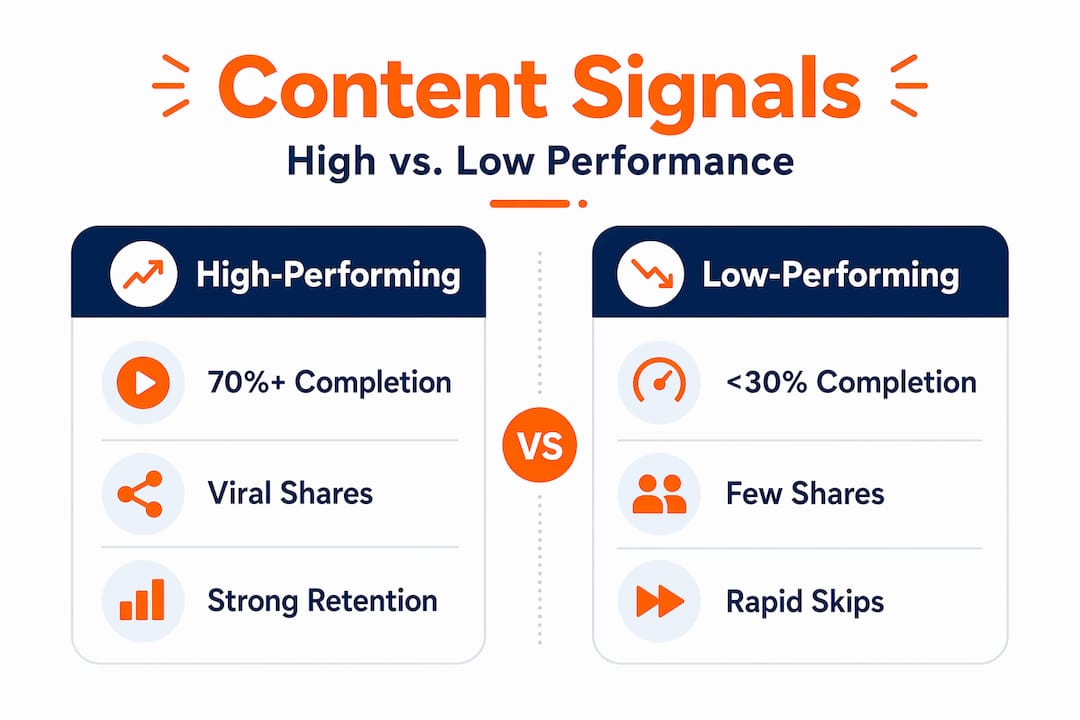
| Factor | High-performing content | Low-performing content |
|---|---|---|
| Completion rate | 70%+ | Below 30% |
| Share rate | Above average for niche | Minimal shares |
| Comment rate | Active discussion | Few or no comments |
| Skip rate | Low | High in first 2 seconds |
| Hashtag relevance | Targeted and specific | Generic or irrelevant |
Pro Tip: Focus on your first one to two seconds above everything else. If viewers skip immediately, the algorithm registers that as a strong negative signal. A compelling opening frame is your single most important optimization lever.
Personalization, prediction, and how the ‘feedback loop’ controls reach
You know what signals TikTok tracks. Here’s how its system evolves, adapts, and sometimes surprises you with shifting reach.
TikTok doesn’t just build one algorithm for everyone. It builds a unique prediction model for each user based on their behavioral history. Personalization is driven by a prediction score that updates with every new user interaction, including negative feedback. This means the FYP is always changing, always learning, and always responding to what users actually do rather than what they say they want.
Here’s how the feedback loop works in practice:
- A new video is uploaded and shown to a small test audience.
- The algorithm measures how that test audience responds: do they watch, skip, like, or share?
- If early signals are strong, the video is pushed to a larger audience.
- If early signals are weak, the video’s reach is limited.
- Every new interaction updates the prediction score and adjusts future distribution.
This “test impression” phase is critical. Your first few hundred viewers are essentially a sample group. Their behavior determines whether your content gets amplified or stays small. This is why posting quality matters so much from the very first second.
Statistic callout: Behavioral feedback loops shape what users see next, and TikTok’s full ranking formula remains proprietary. No creator or marketer has complete visibility into every variable. But the feedback loop principle is well-documented and actionable.
Understanding this loop changes how you should think about content strategy. A video that performs well with its initial test audience gets pushed to new, larger groups. Each new group either confirms or challenges the prediction score. If a video keeps earning strong signals across multiple audience groups, it can reach millions of people even from an account with very few followers.
This is also why improving your video views early in a video’s lifecycle matters so much. More views from engaged users create stronger feedback signals, which accelerates the algorithm’s decision to distribute your content more broadly.
Content repackaging is another underused tactic. If a video underperforms, the issue might not be the core idea. It might be the thumbnail, the opening line, or the hook. Adjusting these elements and reposting can result in a completely different outcome because the algorithm treats it as new content with a fresh prediction cycle.
Practical strategies to boost your TikTok content’s performance
With a solid understanding of the algorithm’s inner workings, let’s turn to strategies you can implement right now for real-world impact.
TikTok’s Creator Academy advises posting high-quality content and iteratively improving with performance data. That’s solid foundational advice, but let’s get more specific about what that looks like in practice.
Step-by-step content optimization process:
Craft a hook in the first two seconds. Your opening frame must immediately signal value or curiosity. Ask a question, show a surprising result, or start mid-action. Viewers decide to stay or leave almost instantly.
Keep videos concise and purposeful. Shorter videos tend to have higher completion rates, which is a strong positive signal. Aim for 15 to 30 seconds for most content types. Longer videos work when every second earns its place.
Use relevant trending sounds. TikTok’s algorithm uses audio as a content signal. Trending sounds get extra algorithmic attention because the platform knows users are actively searching for and engaging with those tracks.
Apply specific, relevant hashtags. Avoid generic hashtags like #fyp or #viral. Use niche-specific hashtags that help TikTok understand your content category and connect you with the right audience.
Post at optimal times. Check your TikTok analytics to identify when your specific audience is most active. General peak times are early morning and evening, but your audience may differ.
Monitor skip rates and drop-off points. TikTok analytics shows you where viewers leave your videos. If most people drop off at the five-second mark, your opening isn’t strong enough. If they leave at the halfway point, your middle section needs work.
Act on negative signals fast. If a video earns poor early metrics, don’t just leave it. Revise the hook, adjust the caption, or rethink the format before your next post.
TikTok confirms that marketers should optimize for early retention and increase completion and finish rates. This is the clearest direction the platform gives creators, and it aligns with everything we know about the prediction score model.
Increasing shares on TikTok is one of the highest-value actions you can drive because shares are among the strongest positive signals in the ranking system. Create content that viewers genuinely want to send to a friend, a family member, or a group chat.
Use analytics for content strategy to identify your top-performing content patterns. Look for common elements in your best videos: similar topics, video lengths, opening styles, or posting times. Then replicate and iterate on those patterns rather than reinventing your approach with every post.
Pro Tip: Set a weekly review of your TikTok analytics. Track completion rate, share rate, and profile visit rate alongside views and likes. These deeper metrics tell you far more about algorithmic performance than surface-level numbers.
Why most creators misunderstand TikTok’s For You Page—and what actually works
Now, let’s go beyond the textbook strategy and share what real-world creators and marketers should focus on.
Most creators treat the For You Page like a lottery. They post, hope for virality, and move on. This mindset is exactly why so many accounts plateau. The FYP is not a lottery. It’s a feedback system, and it rewards creators who understand the difference between vanity metrics and performance metrics.
The biggest mistake we see is an obsession with likes and follower counts while ignoring completion rate and skip rate. A video with 50,000 likes but a 25% completion rate is telling the algorithm that most people didn’t find it worth watching. That’s a damaging signal. A video with 3,000 likes and an 80% completion rate is telling the algorithm something very different: people who started watching wanted to finish. That’s the video the algorithm promotes further.
The “packaging” of your content matters more than most creators realize. Your thumbnail, your opening line, and the relevance of your audio choice all influence whether a viewer stops scrolling. These elements are not secondary details. They are the primary decision points for your audience. A great video with a weak opening will underperform a decent video with a compelling hook every single time.
Iterative testing using analytics consistently outperforms chasing algorithm hacks. There is no secret trick that bypasses the system. Every shortcut that works briefly gets corrected by TikTok’s model. What doesn’t get corrected is genuine audience retention. If you consistently make content that people finish and share, the algorithm will consistently reward you.
Treat your TikTok content as an evolving experiment. Each video gives you data. Each data point tells you something about your audience’s preferences. The creators and marketers who grow fastest on TikTok are the ones who use that data to make smarter decisions with every post, not the ones who post randomly and hope for the best.
Boosting engagement on TikTok is most effective when it’s paired with a clear content strategy. Engagement signals work best when they reflect genuine audience interest, and the strongest way to build that is by making content that earns attention through quality and relevance.
Take your TikTok growth to the next level
Ready to put these strategies into practice? Here’s how you can accelerate your results even further.
Understanding TikTok’s algorithm is the first step. Consistently acting on that knowledge is where real growth happens. At Subme, we’ve helped social media marketers and creators build stronger engagement signals across TikTok and every major platform since 2020.
Our TikTok follower and like packages are designed to strengthen the key ranking signals that the algorithm responds to, giving your content a stronger foundation during those critical early test impression phases. Whether you’re looking to boost likes, grow your follower base, or increase video views, our social media service offerings cover everything you need to compete and grow. We also provide live support so you always have expert guidance when you need it most.
Frequently asked questions
How can I tell if my video is on the For You Page?
Look for the “For You” tag in analytics and watch for increased reach to non-followers. TikTok’s analytics resources help you measure content performance and FYP impressions directly in your dashboard.
What is the most important metric for TikTok’s algorithm?
Completion rate and watch time are the most critical metrics. TikTok’s ranking model favors retention and finish rates as its primary proxy signals for content quality.
Does using trending sounds and hashtags help get on the For You Page?
Yes, relevant trending sounds and hashtags are input signals that increase potential exposure to broader audiences. Using hashtags, sounds, and video context directly influences how TikTok categorizes and distributes your content.
Can negative signals hurt my content’s reach?
Yes, rapid skips, short watch times, and “Not Interested” feedback all reduce your content’s recommendation score. Negative preference signals such as skipping and “Not Interested” taps carry as much weight as positive engagement in the algorithm’s calculations.
Should I delete videos that perform poorly with early audiences?
If a video generates strong negative feedback, revising or repackaging the content is a better approach than immediate deletion. TikTok advises using analytics to iteratively improve content performance rather than simply removing posts that underperform.
Recommended
- Services – subme.lt
- TikTok like paspaudimai – Greitas pristatymas – Aukšta kokybė
- Instagram Post Reach – Fast Delivery – High quality
- TikTok sekėjai – Greitas pristatymas – Aukšta kokybė
Article generated by BabyLoveGrowth